

Crises are unforeseeable challenges that can occur in any industry, even the music industry. In 2018, the Showbox faced a very looming crisis that sent shockwaves through the Pacific Northwest music community: the threat of closure due to proposed redevelopment plans for the building’s site. I will be explaining this crisis and how good PR and communication helped solve it.
History of The Venue
The Showbox is in the heart of Seattle’s vibrant music scene, nestled within the bustling streets of downtown on First Avenue by Pike Street. For decades, this iconic venue has served as a beacon of creativity, hosting legendary performances by both local and international artists.

The venue, built in 1917, had previously been a grocery store and a saloon and cafe before showbiz pro, Michael Lyons, bought the building and transformed it into a nightclub with a motion picture theater and a ballroom. The Showbox had its official grand opening in 1939. The ground floor space of the building served as a commercial space, where in 1946, trombone player, Jumping Johnny Kerns, opened up his store, Kerns Music Shop. After Kerns moved out of the space in 1949, it was used by a variety of businesses such as a bar, a clothing shop, amusement center, and even a peep show.

The Showbox closed its doors temporarily in 1949 but reopened in 1951 as a restaurant before closing its doors again in 1955. In 1958, The Showbox was missing its wall and completely exposed to the outside and the elements after demolition of the building next door. This prompted owner Michael Lyons to sell it to his son, Nathan Lyons, who fixed the wall then sold it to his son, also named Michael Lyons. Then in 1962, the ballroom was converted into a furniture store during Seattle’s World Fair, afterwards sitting empty for a period of time before transforming into a new hip spot called Happening Teenage Nite Club in 1967 until 1968.

The space was then bought by Roger Forbes and being used occasionally as the Talmud Torah Hebrew Academy Bingo Hall, when in 1979, Modern Productions rented the space and reawakened it as a music venue, hosting many popular rock artists at the time. This lasted until 1985 when it closed again, only open for occasional events, before it became Budd Friedman’s Seattle Improv comedy club in 1990. In 1994, new owner Barry Block, turned the venue into Showbox Comedy and Supper Club before Jeff Steichen took over in 1996 and launched Showbox Music Club and it remained as such for a dozen years. In 2001, Kern’s old commercial spot became the venue’s green room restaurant/lounge, while the ballroom’s success took off, booking artists such as Coldplay, Pearl Jam, Macklemore, Katy Perry, Lady Gaga, and Lorde.

With the success, management was able to open a second larger location, called Showbox SoDo near Seattle’s stadium district. In 2008, national firm AEG Live took over both Showbox leases and renamed the green room to its prior name, Kerns Music Shop in 2014.

Then, in July 2018 the Showbox was bought by Omni group who announced that they would be demolishing the building and replacing it with a 44-floor residential tower. The news sent shockwaves through the Seattle community, and within a few days, local preservation groups began meeting to discuss securing the venue as a landmark in order to save it.
PR Strategies
As news of the demolition of Showbox spread, waves of support emerged from fans, artists, community members, preservation groups, and even local politicians who rallied to preserve the venue’s cultural significance. Good public relations played a pivotal role in coordinating efforts, mobilizing support, and advocating for positive outcomes.
Historic Seattle, an advocacy group, played arguably the most significant role in communication during this crisis. They curated an open letter published in the Seattle Times with more than 150 local and international artist’s signatures of support. They regularly posted updates on the landmarks process on their mailing list, website, and social media. They created materials such as a FAQ sheet regarding the crisis, an infographic reflecting Showbox’s history and significance, and tear sheets to put in magazines and newspapers that briefly state the crisis, the supporters, and the call to action.

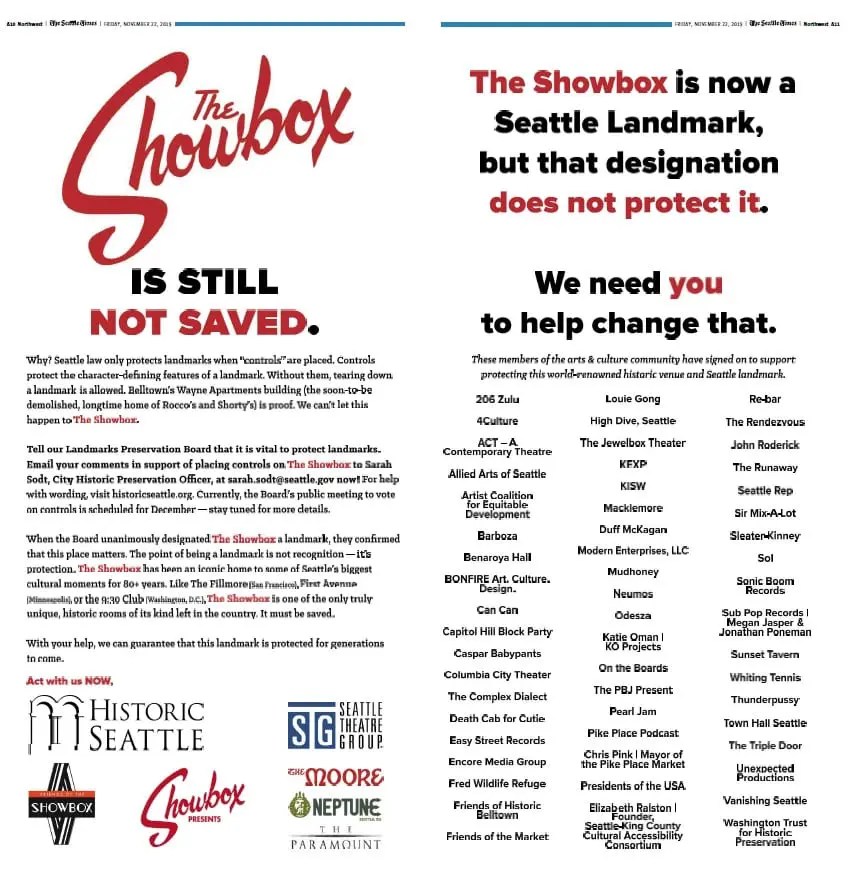

Source: Historicseattle.org
At the forefront of the crisis communication strategy was the acknowledgement of Showbox’s impact on Seattle’s culture. Through compelling storytelling and strategic messaging, advocacy groups and other supporters highlighted the venue’s rich history and showcased its role in shaping the city’s identity while nurturing generations of artists. They emphasized the Showbox’s significance as more than just a music venue – it was a cherished community space, a sanctuary for self-expression, and a symbol of Seattle’s creative spirit. Seattle Magazine and Curbed Seattle each posted an article detailing the history of Showbox in Seattle and its significance while Seattle Times published quotes from readers sharing their memories of Showbox.
Transparency was another cornerstone of the crisis communication strategy surrounding the Showbox’s closure. Supporters worked tirelessly to keep everyone informed about the latest developments, providing regular updates on the status of negotiations, legal proceedings, and advocacy efforts. They utilized various communication channels, including social media, press releases, and community meetings, to ensure that the public remained engaged and informed throughout the process. Local and national outlets such as Vice, Billboard, Seattle Times, Daily Journal of Commerce, My Northwest, Seattle Weekly, KUOW, Curbed and many more covered the chronicle of events unfolding which ultimately helped spread awareness to more than just Seattle citizens and Showbox fans.
Community engagement also played a crucial role in mobilizing support for saving the Showbox. Supporters organized grassroots campaigns, including petition drives, letter-writing campaigns, and rallies, to demonstrate the widespread public support for preserving the venue. They facilitated collaborations between artists, activists, and local businesses, fostering a sense of solidarity and collective action in the fight to save the Showbox.
Strategic partnerships were also instrumental in amplifying the message and broadening the coalition of supporters. Supporters forged alliances with advocacy groups, preservation organizations, and city officials sympathetic to the cause. They enlisted the support of influential figures within the music industry and enlisted their voices to lend credibility and visibility to the campaign.
Famous artists took to social media and news outlets to voice their support. Duff McKagan of Guns n Roses was one of those artists voicing support, tweeting his opinion and call to action and also being interviewed on 97.3 FM Kiro News Radio meanwhile musician Jay Middleton started a petition on Change.org that garnered 119,076 signatures.

And Councilmember Sawant published a blog post on Seattle City Council Blog and her website sawant.seattle.gov voicing her support, explaining that she is preparing a city council resolution urging the Landmarks Preservation Board to preserve the Showbox and asking civilians to contact the preservation board with their support to pass the resolution.
Conclusion
Ultimately, the Showbox Theater crisis exemplifies the power of public relations to effect positive change and preserve cultural heritage in the face of adversity. Through strategic communication, community engagement, and unwavering determination, PR played a crucial role in rallying public support, raising awareness, and ultimately securing a victory for Seattle’s soul.
As the Showbox Theatre crisis resolved due to a bill that gave it landmark status, the resilience shown during the crisis was a testament to the power of music to unite and inspire. The lessons learned from this experience serve as a reminder of the importance of safeguarding our cultural institutions and nurturing the creative spaces that enrich our communities. In the ever-changing landscape of the music industry, public relations will continue to play a vital role in shaping narratives and preserving the voices that define our cultural identity.
PNW music recommendation of the week:
 Emma Wright-Cloutier
Leave a comment